
Photography contract template: what to include, clause by clause
· The Nod team
A plain-English photography contract template for portrait, wedding and event shoots: what each clause means, a sample you can adapt, and how to get it signed before the shoot.
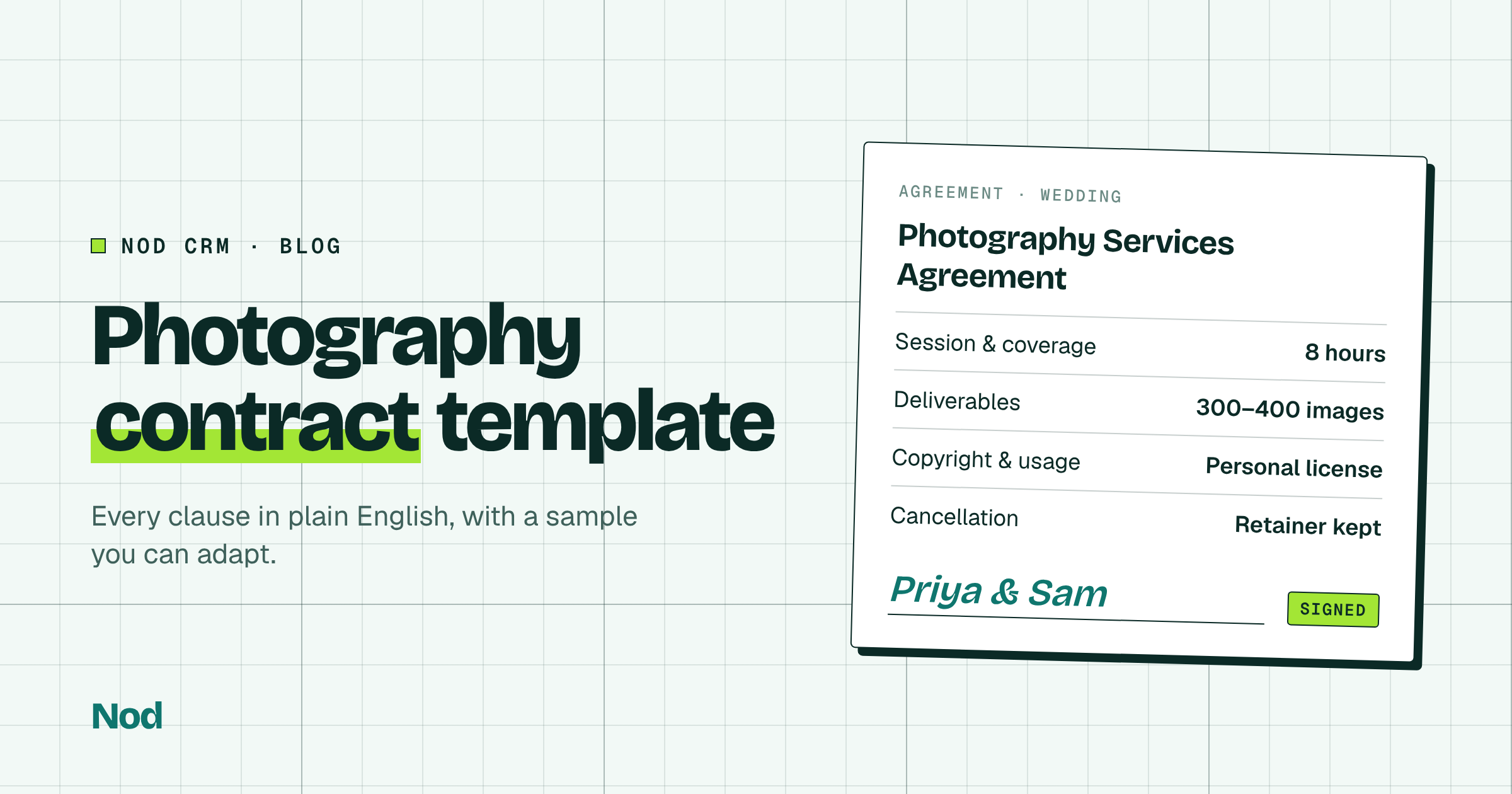
Most photography contract templates online are a blank form and a download button. That gets you a document, but not much understanding of what you are promising. This guide walks through each clause in plain English, gives you a sample you can adapt, and covers the part templates skip: getting it signed and paid before the shoot.
This is general information, not legal advice. Contract law differs by country and state, so have a local lawyer review your template once, then reuse it.
What a photography contract is, and why you need one
A photography contract is a written agreement between you and your client that says what you will shoot, what they will receive, what it costs, and what happens if plans change. It protects both sides. The client knows exactly what they are paying for. You have something to point to when a client asks for "just a few more edits" three months later, or cancels the week before the wedding.
A simple template is usually enough for portraits, family sessions and small events. If you shoot commercial work with large usage fees, work with agencies, or license images for advertising, it is worth paying a lawyer to draft the usage terms.
What to include in a photography contract
1. The parties and the session
Start with who is agreeing to what:
- Your business name and contact details, and the client's full name and contact details
- The type of shoot (portrait, wedding, event, product, real estate)
- Date, start time, expected length and location
- Any second shooter or assistant you are bringing
Be specific about time. "Up to 8 hours of coverage starting at 1:00 pm" avoids the argument about whether the reception counts.
2. Deliverables
Say exactly what the client gets:
- Roughly how many edited images, as a range ("between 300 and 400 edited images") rather than an exact number
- How they are delivered: online gallery, download link, USB, prints
- When they are delivered ("within 6 weeks of the event")
- What editing is included, and what counts as extra retouching
The range matters. It sets expectations without forcing you to deliver weak frames to hit a number.
3. Fees and payment terms
This is where most disputes start, so spell it out:
- The total fee and what it includes
- Whether a retainer or deposit is due to book the date, how much, and whether it is refundable
- When the balance is due, for example 14 days before the event
- Accepted payment methods
- What happens if a payment is late
Many photographers book the date with a non-refundable retainer and collect the balance before the shoot day, so they never deliver work to an unpaid account. If a client runs late anyway, our payment reminder email templates cover what to send and when.
4. Copyright and usage rights
In most countries the photographer owns the copyright by default. Your contract should say:
- You keep the copyright
- The client gets a personal-use license: printing, sharing on social media with credit, keeping copies
- Commercial use (ads, product packaging, resale) needs a separate license
- You may use selected images in your portfolio and marketing, unless the client opts out
If a client wants full rights, that is a different, more expensive agreement. Write it as one.
5. Model and print releases
A print release lets the client print the images wherever they like. Include it in the contract so labs do not refuse their files. A model release gives you permission to use a person's likeness, which matters if you want to use the photos in advertising. For portfolio use, many photographers add a simple consent line to the main contract and use a separate model release for anything commercial.
6. Cancellation and rescheduling
Cover both sides:
- If the client cancels: what happens to the retainer, and whether any further fees apply depending on how close to the date they cancel
- If the client reschedules: whether one reschedule is free, and the notice needed
- If you cannot attend because of illness or emergency: whether you will send a qualified replacement or refund what was paid
7. Limitation of liability
Equipment fails and memory cards corrupt, rarely. Limit your liability to a refund of what the client has paid, and state that you are not responsible for shots missed because of guest interference, venue restrictions or weather. Bringing backup gear and dual-card cameras is the practical half of this clause.
8. Signatures
Both parties sign and date the contract. An electronic signature is accepted in most countries for this kind of agreement, as long as you can show who signed and when.
Sample photography contract you can adapt
Copy this into your own document and replace everything in brackets.
Photography Services Agreement
This agreement is between [Your Studio Name] ("Photographer") and [Client Name] ("Client") for photography services on [Date] at [Location], from [Start time] for up to [Number] hours.
Services and deliverables. Photographer will provide [type of shoot] coverage and deliver between [min] and [max] edited digital images through an online gallery within [number] weeks of the session.
Fees. The total fee is [amount and currency]. A retainer of [amount] is due on signing to reserve the date and is non-refundable. The balance of [amount] is due [number] days before the session.
Copyright and use. Photographer owns the copyright to all images. Client receives a personal, non-commercial license to print and share the images with credit. Photographer may use selected images for portfolio and marketing unless Client opts out in writing.
Cancellation. If Client cancels, the retainer is kept. If Client cancels within [number] days of the session, the full fee is due. One reschedule is allowed with [number] days' notice, subject to availability.
Liability. Photographer's liability is limited to the amount Client has paid under this agreement.
Signed: [Photographer], [date]. Signed: [Client], [date].
Templates by type of shoot
The clauses above cover most work. A few types need extra lines:
- Wedding: coverage hours, a timeline handover date, meals and breaks for the photographer during long days, and a second shooter clause
- Engagement shoot: location fees and travel beyond a set radius
- Event and corporate: who the on-site contact is, and whether images can be used by the company in marketing
- Boudoir: strict privacy terms, no portfolio use without separate written consent, and secure delivery
- Real estate and commercial: usage scope (listing only, or broader marketing), and who supplies property access
- Second shooter: if you hire one, a separate contractor agreement that says who owns the images they take
How to get the booking signed (and paid)
A good contract that sits unsigned in an inbox does not protect anyone. The usual routine is to email a PDF, wait for the client to print, sign and scan it, then send an invoice separately and chase payment. Every extra step is a chance for the client to go quiet.
A faster way is to send one link that carries the booking: the package and price, a signature, and payment. That is how Nod works. You send the proposal by WhatsApp or email, the client opens it on their phone, verifies with a one-time code, signs and pays on the same page, and the invoice is created for you. If you are writing the proposal itself, our freelance proposal template covers what to put in each section.
Common mistakes to avoid
- Promising an exact number of images. Give a range.
- Leaving the balance due after delivery. Collect it before the shoot day.
- Vague usage terms. Say what personal use and commercial use mean.
- No cancellation clause. It is the clause you will most likely need.
- Using a template you have not read. If you cannot explain a clause to a client, rewrite it.
Photography contract FAQ
Is a free photography contract template legally binding?
A contract is binding when both parties agree to clear terms and sign it, whether it started as a free template or a lawyer's draft. What matters is that the terms are clear, fair and fit the law where you work. Have a lawyer review your version once.
Can I edit a template for each client?
Yes. Keep the standard clauses fixed and change only the session details, deliverables and fees for each client. Changing the core terms every time makes mistakes more likely.
Do I need a separate model release?
For personal and portfolio use, a consent clause in the main contract is usually enough. For advertising or commercial licensing, use a separate model release signed by each person who appears in the images.
How do I create a contract for photography?
Start from a template like the one above, fill in your business details and standard terms, have it reviewed once, then save it as your master copy. For each booking, fill in the session details and send it for signature together with the payment request.