Freelance proposal template: what to write in each section
· The Nod team
A freelance proposal template you can copy, with what to write in each section, how to scope and price the work, and how to get from proposal to signed and paid without a week of back-and-forth.
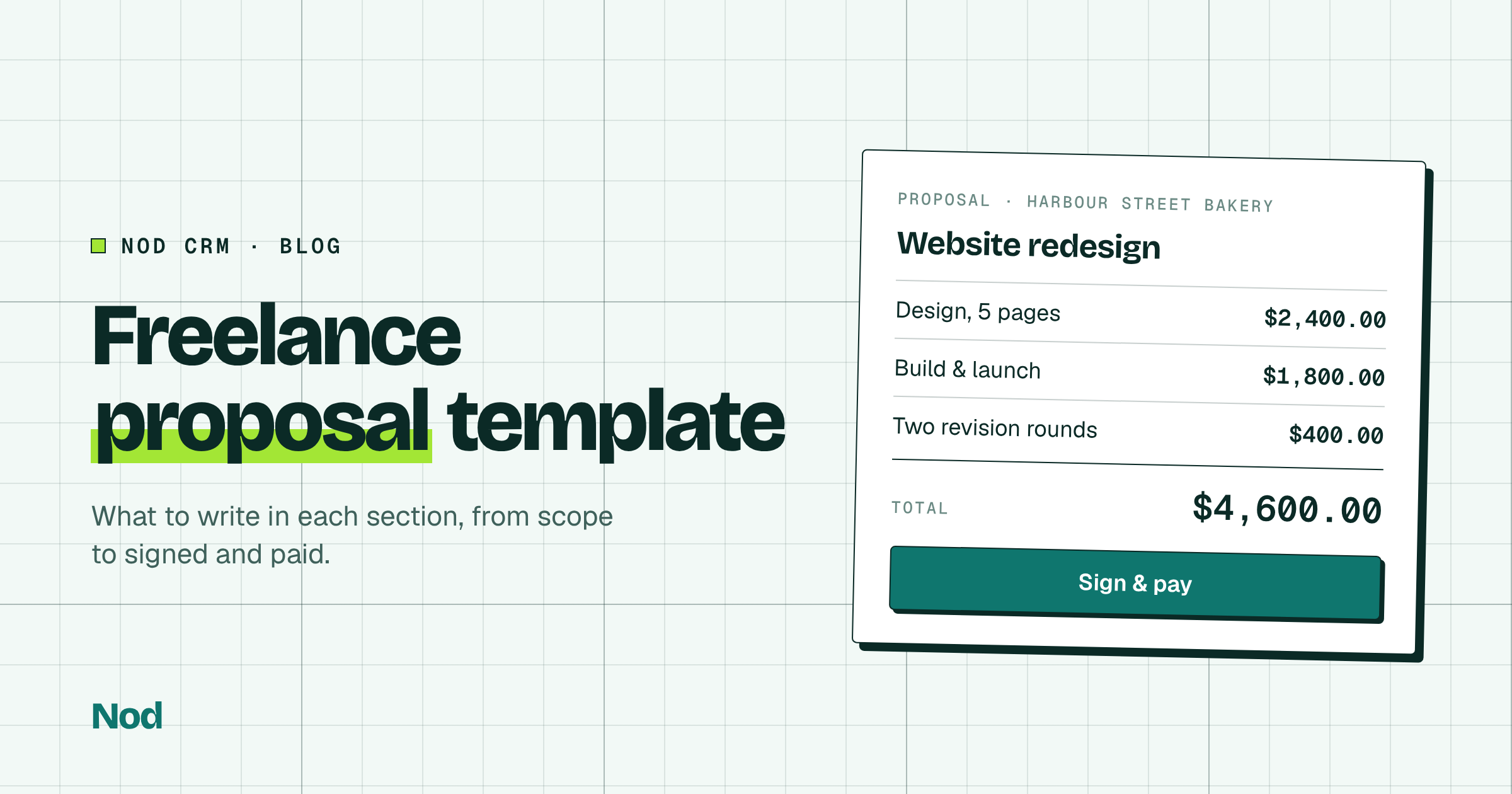
Most freelance proposal templates give you a nicely designed file and nothing to put in it. The design is the easy part. What wins the job is what you write in each section: a clear read of the client's problem, a scope they can't misread, a price that is easy to say yes to, and an obvious next step.
This guide gives you a template you can copy, then walks through what to write in each part.
What a freelance proposal should include
A good proposal answers the client's questions in the order they ask them:
- Do you understand what I need? A short summary of their problem and goal.
- What exactly will I get? Scope and deliverables.
- When? Timeline and milestones.
- How much, and how do I pay? Pricing and payment terms.
- What happens if things change? Revisions and change requests.
- What do I do now? How to accept, sign and get started.
If any one of these is missing, the client either asks you (a delay) or assumes (a dispute later).
Freelance proposal template you can copy
Paste this into a Word document, Google Doc or your proposal tool, and replace everything in brackets.
Proposal for [Client name]: [Project name]
Prepared by [Your name / studio] on [date]. Valid until [date].
Your goal
[Two or three sentences in the client's words: what they want to achieve and why now.]
What I will deliver
• [Deliverable 1, with format and quantity]
• [Deliverable 2]
• [Deliverable 3]
Not included
[Anything the client might assume is included but isn't.]
Timeline
• [Milestone 1]: [date]
• [Milestone 2]: [date]
• Final delivery: [date]
Investment
• [Line item]: [amount]
• [Line item]: [amount]
• Total: [amount and currency], plus [tax, if applicable]
Payment terms
[For example: payment due within 14 days of acceptance, payable by card or bank transfer.]
Revisions
[Number] rounds of revisions are included. Further changes are billed at [rate].
Next step
To go ahead, sign below and pay [the invoice / the first payment]. I will confirm the start date within one working day.
How to write each section
Lead with the client's problem, not your bio
The opening is about them. Reuse the words they used in the inquiry: "You want the new site live before the March launch, and the current one is hard for your team to update." Clients relax when they see you were listening. Your experience belongs in one short line, or in a link to your portfolio.
Make the scope impossible to misread
Vague scope is where freelance projects go wrong. Compare:
- "Website design" (vague)
- "Design for 5 pages: home, about, services, pricing, contact. Desktop and mobile layouts in Figma. Two rounds of revisions." (clear)
Add a short Not included list. "Copywriting, stock photo licenses and hosting are not included" saves an argument later.
Put prices on line items
A single total invites haggling. A short list of line items shows what the money buys, and lets the client drop an item instead of asking for a discount. Use the client's currency and state whether tax is included. If the client is abroad, say which currency they will pay in.
Offering two or three packages (for example, essential, standard and complete) works well when the client's budget is unclear. Keep the differences obvious.
Set milestones with dates
Dates make the proposal real. Tie each milestone to a deliverable the client can see, and note what you need from them and by when ("content for the about page by 4 March").
Make accepting easy
End with one clear next step. "Sign and pay to book the start date" is better than "Let me know your thoughts", which invites a week of silence. Give the proposal an expiry date so it doesn't sit open indefinitely.
Customizing a template for each client
Keep two kinds of sections:
- Reusable: payment terms, revisions policy, process, about you. Write these once and keep them in a master copy.
- Client-specific: the goal, scope, timeline and prices. Write these fresh every time.
If you sell the same services often, keep a list of your standard line items with prices so you can build a proposal in minutes instead of rewriting it.
From proposal to signed and paid
A proposal that wins is only half done. The usual next steps are slow: the client downloads a PDF, prints and signs it, scans it back, then waits for a separate invoice. Each step is a chance for the deal to stall.
A faster flow puts everything behind one link: the scope and price, a signature, and payment. That is what Nod does. You build the proposal from line items or your catalog of services and send it by WhatsApp or email. The client opens it on their phone, verifies with a one-time code, signs and pays on the same page through Stripe or Razorpay, and the invoice is created automatically in their currency with the right tax lines. You get a ping when they open it, and reminders go out if payment is due. Our payment reminder email templates cover what those reminders should say.
Proposal mistakes to avoid
- Generic copy. If you could send the same opening to every client, rewrite it.
- Vague scope. List deliverables with quantities and formats, plus what is not included.
- Hidden costs. Show tax, expenses and extra-revision rates up front.
- No expiry date. Open-ended proposals get forgotten.
- No next step. Tell the client exactly how to say yes.
- Too long. Two pages is plenty for most freelance projects.
Freelance proposal FAQ
How long should a freelance proposal be?
One to two pages for most projects. Long enough to cover goal, scope, timeline, price and next step, short enough to read on a phone.
Should I include my rates or a fixed price?
Fixed prices per line item are easier for clients to approve. If the scope is genuinely uncertain, give a fixed price for a first phase and estimate the rest.
What format should a proposal be in?
Word, Google Docs and PDF all work. A link the client can open on their phone, sign and pay from is faster than any file.
Is a proposal the same as a contract?
Not always. A proposal describes the work and price; a contract sets the legal terms. For small projects, a signed proposal with clear terms often serves as the agreement. For larger work, use both. See our guide to photography contract templates for what a contract should cover.